Sunday, May 31, 2015

The Hopeful Farmer - the Japanese Knotweed edition

    Here on Rivendell Farm we have inherited Japanese Knotweed.
 To inherit this means you have been given a never ending supply of it.  This invasive plant was imported to the US from Great Britain, after having arrived there in 1825 from Japan for use as an ornamental garden plant.  It has its ornamental side, and the flowers are well liked by bees, but just try to keep it in a garden! Like bamboo, which it resembles in height and segmented stems, knotweed  sends rhizomes underground, forming a dense web of roots which all have the potential for sending up more shoots.  Any bit of root left in the ground can start the entire growing process.  It is difficult, if not impossible to eradicate this plant. In Japan it has fungus and  animals which keep it in check, but this is not the case in its new host countries.  In the UK there are actual laws about it - if it is in your property, you must report it, and work on getting rid of it.  It will creep up through  your lawn, through pavement - and there are documented instances in the UK of it growing up through the foundation and into people's houses!
working its way into the lawn

Apparently there are chemicals (Roundup) that can help - but even with cutting and applying these chemicals to the cut off plant, it can take three or four years to kill it - and EVERY stem must be treated!  Every time it is cut back, it has to work harder to come back to full height.  Cows will graze on it, I am told, as will goat (but only under duress).  I want neither chemicals nor cows, so I am working on other ways to control it.
   
     Ater two afternoons of cutting out a five foot section of the invader, and disturbing  a bird with nestlings


(a problem when changing the habitat - even if it is to remove invasives), I decided I needed a different approach.
A very distressed bird

the reason for her great distress
     Knotweed is hollow, and very fibrous.
 Although I have taken a few year hiatus from it, I have been making paper for quite some time, and why not try this "weed" as a fiber source for it?  Being a plant that is very sturdy, I am trying different ways of breaking it down to get to the fiber.  I gathered a bunch of the dead stalks from last year, chopped them up and started soaking them in a bucket.
really nice fibers, once I remove the pith
 I also took some of the newly chopped stalks and did the same.  I suspect both methods will work, with a great deal of time for the rotting process.  I will also try to more expedient method of  boiling some of the new stalks, some with  soda ash, some without.  I'll keep you posted on how it goes.  The outside of the  stalks are green with a purply red streaking - I wonder if I can make dye from it?  hmm...
     Knowing how long this process may take, I am looking at other  methods of using this plant - like eating it.  I have eaten it very young, it is like s lemony asparagus - very nice - but my stand is too woody at this point.  So I have been looking at other ways to fix it.  Apparently if I peel it then boil it and puree it, I can use some of the mature stalks.  I have found recipes for pies (and I do make a mean pie!)  and crumbles, as well as savory methods of serving it. It is supposed to be a healthy tea, if made from the roots.  I tried this - it tasted rather like dirt - and honey did not help that much.  I think boiling the stalk itself for a lemony tea may be the better course of action.  I will keep experimenting and researching.  So if you come to my house for dinner, do not be surprised if it is on the menu!
knotweed root

Japanese knotweed root tea - 

Friday, May 1, 2015

You are beautiful!

    I can't keep quiet anymore.  I recently read a friend's post about how she might wear a sleeveless shirt this summer despite her "arm issues."  I hear my students saying how they are too fat,  too short, hate their skin, etc.  You are beautiful.  If we all looked the same, how boring this world would be?   Who has the right to tell you what you should look like?
    I know there are things we may all want to change - I would like to lose a few pounds.  So I'll lay off the ice cream for a bit and walk the dogs or  work  on more fencing at the farm - exercise and less calories, and I can achieve the change I seek.  But you know what, even at my current weight - I am beautiful.
     I teach a Stage Makeup class, and since my students must look in the mirror for every class, we begin the semester by looking at ourselves and repeating, "There is nothing wrong with my face."  Any time they whine about, "I hate my nose, (chin, skin, forehead - add the appropriate facial feature) I tell them to repeat it again - there is nothing wrong with  my face. If I say something negative about myself - usually my "bad hair days", they will throw it back to me - there is nothing wrong with your hair!  The best thing that happened this term was when one of those students had her photo on the campus web site and someone asked about the photo, which was not complimentary  She replied that she had no idea why they used that photo, "because it is a bad  picture, and I AM PRETTY!"   What a victory to hear a young woman say that and mean it!
     I constantly see photos of pathetic celebrity women who have bought into the Hollywood ideal that to be successful you must be young and wrinkle free.  They have  destroyed their natural beauty with plastic surgery, Botox, and silicone injections, and they look sad and unnatural.  What a shame.
     Embrace each wrinkle - they say, "I have smiled a lot.  Squinted on a sunny day.  Worried about someone.  LIVED."
     You are beautiful.  Believe it.

Monday, April 27, 2015

Babies at the farm

    The delivery of the lambs from two ewes has doubled our flock.  We are now the proud caretakers of ten sheep, (and thinking we were quite right in not breeding our third ewe).  Maxine gave us twins, and last Wednesday, Arwen dropped triplets, as we suspected.  The twins are male and female.  Thankfully, the triplets are all ewes!  The idea of culling our first babies was hard to swallow, but no farm needs a lot of rams. The trick with the trips is that they are white like their mom and dad.  Pippin has one defining mark - a small black dot on her hip.  Merry and Galadriel are both white - just white.  I am hoping one develops a slightly dustier looking nose or something allowing us to identify her without having to read her ear tags.
     Yesterday, we let the lambs and mamas out on the pasture for a bit - they loved it.
first steps outside the barn

I have an oak leaf!
      A few of neighbors stopped by to see the lambs, and Ted, an old shepherd himself, warned us to watch out for the eagles.  This had never occurred to me.  We have at least one mating pair of bald eagles living near by.  Ted said he has always been more worried about the eagles stealing his lambs than the coyotes.  We know the llama will help stave off a coyote insurgence, but what would he do with an aerial attack?
Time to rest for the 3 day old lambs


The big kids on the block playing King of the Hill.
      Babies on the farm come in all shapes and colours, including the new chicks.  We had our youngest go to pick out half a dozen new chicks (pullets all - NO MORE ROOSTERS!) and they are now in the basement in their brooder.
So Spring is happening as it should on a farm - new arrivals, some plowing, some planting and hopes for the right amounts of sun and rain.  As our friend, Ted, said when he saw the lambs, "You're in it for real now."


Wednesday, April 15, 2015

Firsts for the farm

   Last week we had the sheep sheared for the first time.  We were lucky to have a wonderful shearer named Nancy Meyers who was willing to talk to us and  give us tips, etc.  She said the sheep were looking good, and except for all the vegetable matter in their coats, the fleece was gorgeous.  We knew we had to set up a different feeder style so the hay doesn't sit on their necks and so the rams cannot sleep UNDER the feeder, making for hay monsters in the morning. Here is a quick look at some of the shearing.
Maxine, pre-shearing


Arwen - pre-shearing
Sam being sheared

Nice crimp in this fleece

Rosie was the least happy of all of them

Arwen shorn

Maxine shorn
scraps of fleece showing the colors of the fleeces


   After the shearing - as in three days later, Maxine gave us a beautiful set of little black hst twins.   Drew arrived for morning feeding and chores and they had just been born. The ram is Aragorn, and the ewe is Eowyn.  They are doing well - eating, gamboling about the pen, and sleeping well.  We put them in little sweaters as Saturday was raw and windy and we wanted to help them keep warm.  They are the remainders of a felted sweater I made slippers from this winter, but the sleeve remnants were the perfect size.  They are cut in such a way that it looks like they are trying to be super heroes.  I just call them Super Ram and Super Ewe. 
Just about an hour old

Aragorn

Super Ewe in the foreground and Super Ram behind

Eowyn is not going hungry

Arwen, still VERY pregnant - we are hoping for triplets from her, and a little worried it might be quads.

Our noble Elrond, always on guard

tired little lambs

King of his corner


Monday, April 6, 2015


                 A man died last night.  This statement can be made all over the world, and someone will smile sadly, or weep for him.  Here and now, it is my turn.  A man died last night.  He was a husband, a father, a grandfather, and a friend.  He was a quiet man of magic – chuckling when we were amazed by his entertainments.  He never failed to have a smile.  He never failed to have a magic trick in his pocket, or up his sleeve.
                 A man died last night; he was the father of my very dear friend.  He was my  “adopted” dad – who was there through the years of teenage giggling, and angst,  sleepovers,  boyfriends,  concerts, and Girl Scouts meetings. He could blow enormous bubbles.  He could hunt.  He could bend a penny.  He was a constant in the lives of many of us.
             He may not be remembered for doing some really big thing, but many will remember him for all the little things he did.  And for his smile.  And for his chuckle.  I will miss that chuckle.
Goodbye, Pa Noll

Saturday, March 14, 2015

Naga Mandala: A Play With A Cobra - the scenic design process

  Naga Mandala is a play by Indian playwright Garish Karnad.  I first saw this show in 1993 at the Guthrie Theatre and was enchanted by the play's structure - it is a play about a man who takes refuge in an abandoned Indian temple, who is told a story, and it comes to life on stage, but the man and "the story" (played by a young woman) are always present on the stage, and the set is always the temple.  The audience must use their imaginations to see the house, and village told of by "the story," and the anthill that plays such a large role.
     In 2001, I was very lucky to have the opportunity to design scenery and costumes for this play at St. Mary's College of Maryland, and it was selected to compete at the KCACTF in Pittsburgh.
2001 Naga Mandala, St. Mary's College of MD

The flames - 2001 production of Naga Mandala at St. Mary's College of MD
    Approximately five years ago I began suggesting we produce this play at SUNY Oneonta.  For various reasons, it never made the season, but tiny water droplets can carve caves over time, and so  suggesting this play every year, eventually got it on the stage.  
     It was imperative  for my design to turn the theatre into the temple - this is a  flexible space - currently set up in a strange cornered proscenium layout with quasi upstage depth.  As soon as the audience walked in I wanted them to see the temple - to be in the temple. I wanted the set to be very textural.  The carving on temples in India is incredibly detailed and so prolific, and I wanted to do as much as we could to emulate that (albeit in a simplified way due to our limited budgets and student crew availability).
 It was important to give the lighting designer ample opportunity for playing with light and shadow.
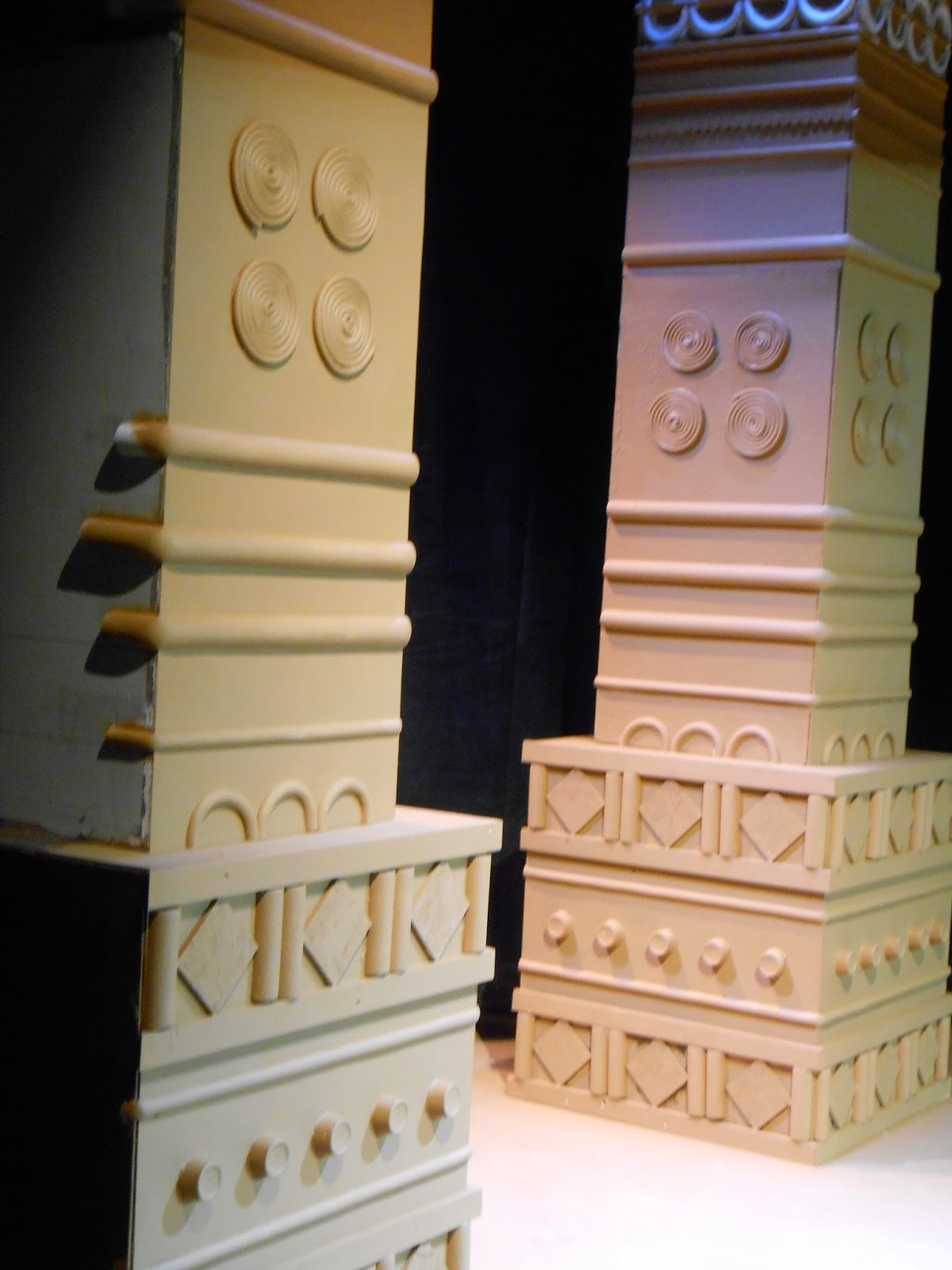
     How could I do this and keep the cost down?  Recycle.   In graduate school I had the honor and pleasure of working with renown designer, Desmond Heeley.  He  created a design for Oedipus Rex in which the columns were decorated with garbage - smashed soda cans, plastic cutlery - things that could be salvaged from the trash and applied to the columns.  It looked AMAZING.  I have never forgotten his work, and it came to mind as I approached this.  So, I got the entire Theatre department to start saving bottle caps - water bottles, milk jugs, soda, juice - all of the caps were brought in by students, put in boxes left near  trash cans asking to the caps, and the occasional foray into the dumpster.  We got several paint cans worth, sorted by size.  I also used  plastic yoghurt containers, as well as "canned" fruit in plastic snack packs.   Along with ethafoam rod/ backer rod, I applied the recycling to the  various columns, and the frieze band that bordered the entire set.
     All of this had to be painted in foam coat, as did the mutilated god, Ganesha - who had no lower arms or hands and who had ears that were broken off.  Then the entire set - floor, walls, columns, and broken column pieces needed to be based, then rag rolled in a two color  texture, and finally Ganesha painted  to look like he was a different type of stone.  Aerial silks had been rigged to created  hair for one scale altering scene, and finally, the eight foot square mandala I had painted needed to be installed in the floor.
   There were, as with all designs, things I wish I had had more time to do.  I had wanted to paint in large ashlar block outlines on the walls and floors, but in academic theatre - well, all theatre, sometimes you have to adjust due to time constraints, so the outlines did not happen.  Overall however, I am pleased with the outcome.
    What follows is a photo progression of the process.
laying out the mandala


some of our stash of caps

recycled materials


pilasters lined the walls

laying out the frieze band

supports  for the cobra pillar

reusing masonite from a previous show as well as the caps

Sonotube is a scenic designers friend!


naga pilaster in progress

foam coating the plastics

frieze band based


Chicken wire covered with muslin give a nice scale patter for the naga pillars 
view of the upstage area from above


pilaster, part of the frieze band, "broken" pillar pieces


beginning the rag roll colors

my sketch for Ganesha, and the beginning of the carving (I am no sculptor!)

no hands, broken ears
Rani, Naga, and the flames
Rani and Naga, looking through to the upstage area

Rani, sleeping
The Story and the song
Rani and Appanna in front of the village elders
Naga in the hair

the flame, leaving the lantern

Stage right

Stage left


Ganesha (or an "absent god") and the naga mandala

Naga pilasters defined the edge of the space